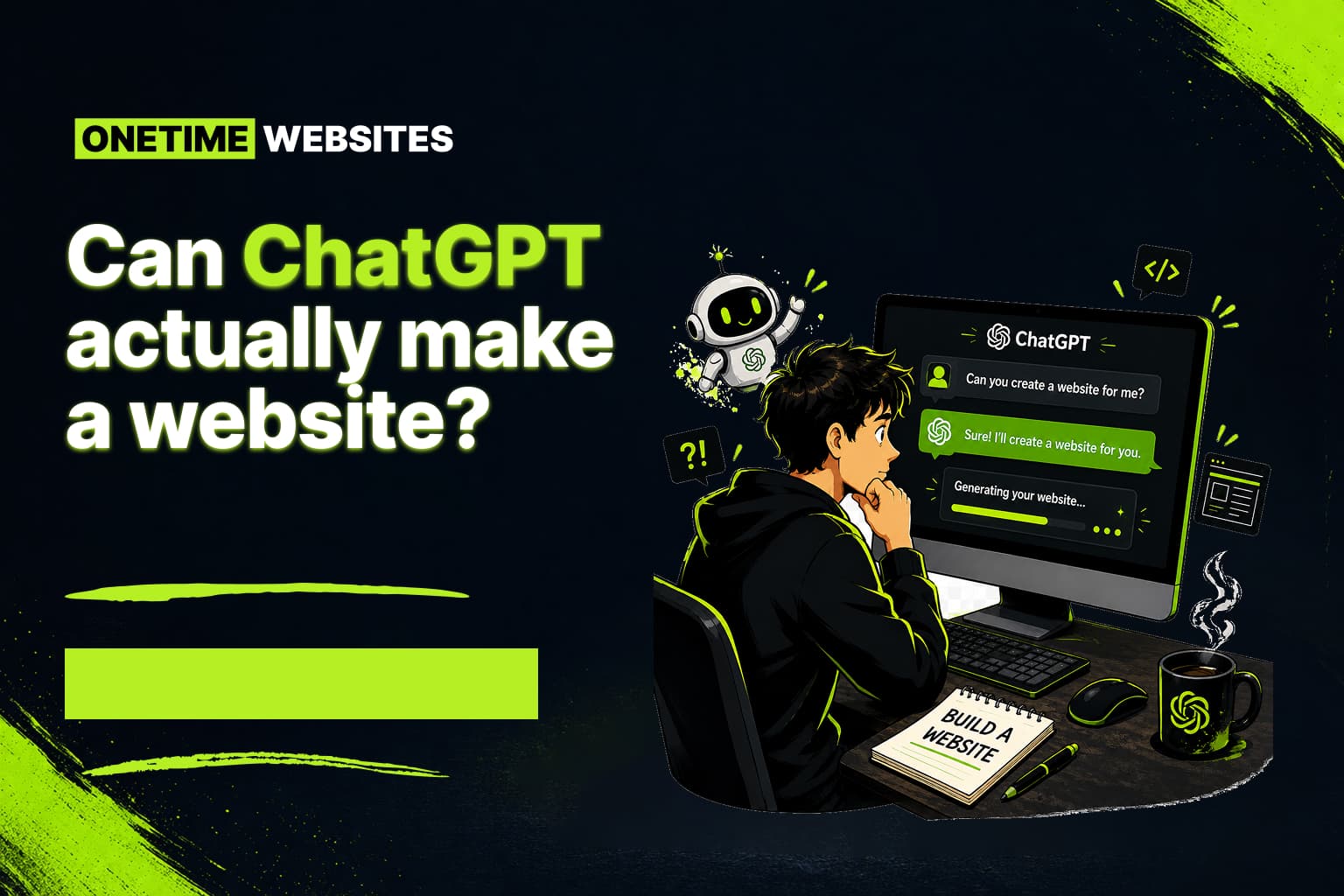
Can ChatGPT Make a Website?
The answer is no. ChatGPT cannot host or publish a live, clickable website on its own.
What ChatGPT can do is write all the "raw" ingredients, the code (HTML, CSS, JavaScript, PHP) and the written content (copy, headlines, meta descriptions). However, it cannot give you a web domain (like yourcompany.co.uk), let you host your files online, or manage server infrastructure natively.
The Rumor VS Tech Reality:
There is a widespread misconception going around right now that you can use a prompt to ask AI to "build a website" and immediately launch a fully working business online. The reality is pretty different, While ChatGPT is an incredible tool, there is a massive gap between generating code on your screen and launching an actual, working website on the internet.
ChatGPT excels at generating front-end code, writing HTML for structure, CSS for styling, and basic JavaScript for interactive visuals. When you save this code as an ".html" file, you will be able to open it on your laptop and see what looks like a functioning web page, but here's the thing: it's only a file on your computer.
Because it sits on your hard drive, nobody else on the internet can see it or open it. To make it a real website, you still have to buy a domain name, get web hosting, and actually post those files online.
Why AI Files are not a Live Website?
Basically, opening a file on your computer is not the same as having a live presence on the internet. As it stands, ChatGPT output operates like a static "template" or "digital sketch".
Here is why that sketch stays stuck on your computer:
- It lives on your hard drive: Look at the address bar when you open the file. It says
file:///C:/...instead ofhttps://... - No one else on the internet can see that address or visit it unless you buy a domain, set up hosting, and push those files onto a live server network. This is the part most people miss. A real website needs three things to actually work on the network:
- Web Hosting & Domain: A paid server that is plugged into the internet 24/7 so people can type in your web address and reach your site.
- A Back-End Server & Database: The hidden engine behind the scenes that handles real actions like saving customer leads, processing credit card payments, or storing user logins.
If you ask ChatGPT to make a contact form, it draws the form boxes and the "Submit" button on your screen. Visually, it looks complete. But if a visitor fills it out and clicks submit, the lead vanishes into nowhere. Why? Because ChatGPT only wrote the visual surface; there is no backend server or database connected to receive and save that email.
Without that network connection and database, no AI code is truly "ready to post" for a real business.
How to take advantage of ChatGPT?
Don't get me wrong, this doesn't mean you shouldn't use ChatGPT. Even though it can't host a live site, developers and creators use ChatGPT every day to speed up their work. Its real job is to be a coding assistant:
- Writing Boilerplate Code: It can generate basic page layouts and standard sections in seconds instead of writing every line by hand.
- Writing Content: It drafts headlines, service descriptions, and main text directly alongside the code.
- Troubleshooting: If a piece of code is broken, developers paste it into ChatGPT to find and fix syntax errors instantly.
If you have an idea in your head, you can use ChatGPT to quickly spit out a rough layout and see what it looks like in a browser. It gives you a physical starting point so you aren't staring at a blank screen.
Once you have that "basic sketch", you can take it to an actual UX/UI designer or software developer. They can look at your draft, fix the layout, write the backend code so your contact forms actually work, and get it safely hosted online.
To conclude I want to clarify why ChatGPT was created: it was built as a large language model (LLM) to understand, process, and generate human-like text based on patterns in data, not to run computer infrastructure.
So why can it generate a code file? Simply put, writing code (HTML/CSS) is just writing text. Since code follows strict language rules, ChatGPT excels at writing and formatting it instantly. Creating a live website requires physical computing power and active network access. Renting server hardware, assigning IP addresses, managing web domains, and maintaining running databases. ChatGPT is software that generates text; it does not own servers, host files, or manage internet connections.
If you're feeling stuck, have no idea where to start, or want to sketch an idea quickly without spending money, ChatGPT is a fantastic tool and advisor to get the ball rolling. Just remember that it isn't a live web host. I hope this clears up the reality for anyone wondering if they can build a site with AI, so you aren't left confused when an offline file doesn't suddenly work like a live business on the internet.