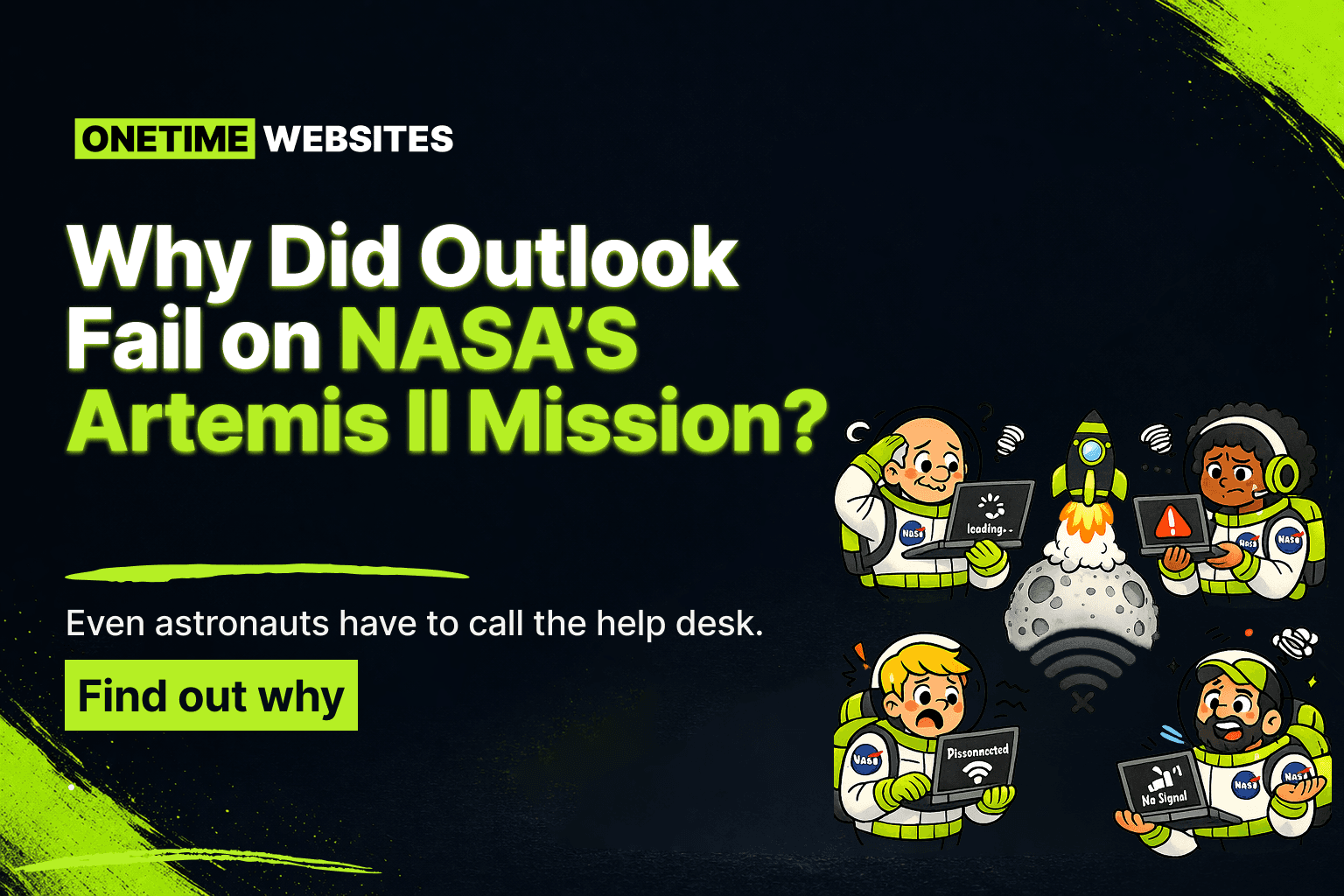
Even 250,000 Miles From Earth, Reid Wiseman Still Got Hit with the Ultimate Workplace problem: Email down.
While on the Artemis mission, as the astronauts were travelling tens of thousands miles away from earth, astronaut Reid Wiseman ran into a problem that would feel familiar in almost any workplace: his email stopped working.
From Orbit, Wiseman contacted Mission Control and asked if they could take a look. The request was straightforward, check the system, figure out what went wrong and get it working again.
Mission Control did exactly that. Engineers remotely accessed his device, identified the issue and restored functionality. Outlook reopened, though it remained offline which was expected given the spacecraft’s limited connectivity.
But…
Wait - why is Outlook even there?
Likely a Microsoft Surface Pro used for communication and routine tasks. On missions like Artemis II, software such as Microsoft Outlook isn’t used for fight control, but for everyday operational support, things like scheduling, documentation, and routine communication.
Rather than building custom tools for these tasks, NASA relies on commercial off-the-shelf software. It’s faster ti deploy, familiar to astronauts, and avoids reinventing basic functionality like email and file management.
Still the contrast is hard to ignore.
At first glance, it sounds trivial-almost humorous. But beneath that moment is a powerful lesson for modern website technology. The way Nasa handles software failures in space reveals something many web systems still struggle with: how to fail without breaking everything.
The crew is part of the first human mission to travel this far from earth since Apollo 17. The spacecraft it’s systems and the planning behind it, represent years of development and precision engineering. At the same time onboard devices like Microsoft Surface Pro are used for routine tasks-documentation, media storage and basic software tools like email.
What stands out isn’t the malfunction itself but the overlap between the ordinary and the extraordinary a deep space mission, briefly intersecting with a problem most people deal with every day.
But… Why did this happen?
Commander Wiseman discovered two separate instances of Outlook running simultaneously on his Microsoft Surface pro (personal computing decvice) This redundancy caused a software conflict that made the application non-functional and prevented emails from syncing.
According to Artemis flight director Judd Frieling Outlook often encounters configuration problems when it loses a direct high-speed network connection. As the Orion capsule moved further from earth the transition to high latency deep space networks caused the local profile to break, spawning the second non-functional instance.
The astronauts use Commercial Off the Shelf COTS software for personal tasks like scheduling and family emails.
Unlike the spacecraft’s primary flight systems, which are custom-built and radiation-hardened, Outlook is designed for terrestrial internet connection and struggled with the intermittent, indirect connectivity of deep space.
While traditional missions relied on show radio waves, the Artemis II mission utilizes the Orion Artemis II Optical Communications System (O2O).
Laser Communication: This system uses lasers to beam data at speeds up to 260 mbps. This high bandwidth allows the spacecraft to handle “heavy” commercial data like 4K video and large email synchronization files that older radio systems couldn’t support.
NASA uses a global array of massive antennas in California, Spain and Australia to maintain a continuous tight beam connection with the spacecraft as the earth rotates.
-It’s like trying to paint a picture with a brush that has a 2-second delay: by the time you see where you put the paint, you’ve already gone past the edge of the canvas.
That’s why, when two Outlook windows opened at the same time for Reid Wiseman, it was total chaos: every click he made took so long to process that he ended up opening too many things, crashing the memory on his Surface tablet, and forcing the technicians back on Earth to tell him, “Please, put down the tablet and let us handle this.”
Can you imagine being an elite pilot and having to ask a technician in Houston to “reset your password” because the system crashed?
It’s a massive contradiction: we can navigate a spacecraft to the Moon with laser-point precision, yet we can’t stop a basic "New Outlook" glitch from freezing a tablet. The truth is, NASA didn't try to make Outlook perfect; they just made sure its failure wouldn't matter. They’d rather deal with a "drunken mouse" on a personal Surface Pro than risk letting buggy, everyday software anywhere near the ship’s actual brain.
Even on the most advanced mission in history, we’re still tethered to the same tech headaches we face at our desks. It’s a humbling reminder that while we’ve conquered the vacuum of space, we still haven’t quite conquered the "Not Responding" window. Even 240,000 miles away, someone still has to call IT.